College entrance examinations have existed for decades. The SAT, first administered by the College Board in 1926, has since undergone numerous changes to its content, duration, and scoring. Its popular counterpart, the ACT, was first introduced in 1959 and has also changed significantly over the years.

Do colleges care which exam I take?
Good news – colleges accept both ACT and SAT scores from applicants and have no preference for which one students choose to take. Before preparing for and taking these exams, it’s a good idea to learn about each exam and its differences to determine which exam you may wish to proceed with; core differences may be better suited to meet the needs of diverse students.
The SAT: structure, content, and scoring
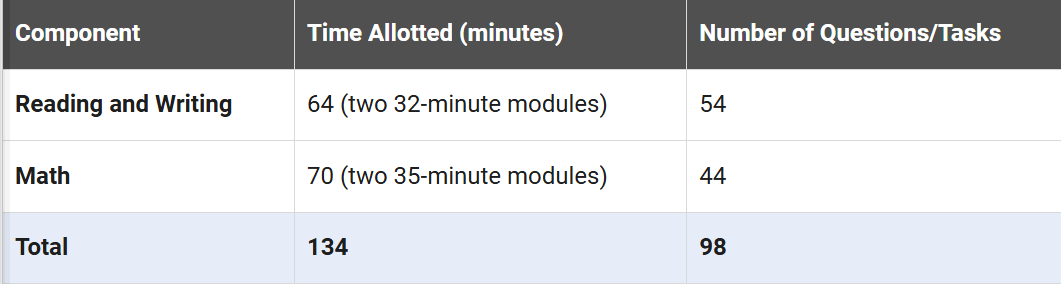
In its current format, the SAT consists of two sections: Reading and Writing (EBRW) and Math. Students are given 64 minutes to complete the Reading and Writing section and 70 minutes to complete the Math section, and each section is divided into two smaller modules of equal length. Students are given 2 hours and 14 minutes to complete both sections, with a 10-minute break in between–almost an hour shorter than its previous version. In 2021, the SAT stopped offering an additional essay section.
In Spring 2024, the SAT went fully digital, allowing students to ditch pencil and paper for a laptop or tablet that operates Bluebook, the SAT’s digital testing application. Additionally, the SAT is now adaptive, meaning the questions a student is asked on the exam will change and adapt based on their answers. Using a multi-stage adaptive design, the SAT (and PSAT)’s questions will change based on how students perform in the first module (of two) for each section.
In the table below, you can see how each section (and modules) are generally organized. Students can expect the first modules of both the Reading and Writing and Math sections to contain a broad mix of easy, medium, and hard questions. Based on the accuracy of responses, the sets of questions in the second modules will be more or less difficult. Most questions on the exam will be multiple choice.
College Board has implemented adaptive testing to provide a better test experience for students. By offering this new adaptive test, students can:
- Complete the SAT in 2 hours instead of 3 due to the exam’s increased ability to measure their content knowledge
- Toggle between questions in a singular module to preview, mark, or return to questions as they are completing the set of questions
In the Reading and Writing section, students can expect to be tested on their reading comprehension, analysis, and writing abilities. Complex reading passages will have accompanying questions to evaluate students’ understanding of the text. Vocabulary will be tested, most often through contextual understanding, and knowledge of proper grammar (such as punctuation and subject-verb agreement) will also be evaluated. All questions are multiple choice.
In the Math section, students can expect to be tested on algebra, advanced math, problem-solving and data analysis, geometry, and trigonometry concepts. With the exception of some free-response answers, questions will also be multiple-choice. Students can access a built-in graphing calculator throughout the Math section.
Students can score between 200-800 for each section, combining them for a total score between 400 (the lowest possible score) to 1600. To receive a perfect score of 1600 on the SAT, students must earn an 800 on both sections. There are no penalties for answering incorrectly; you only earn points for correctly answered questions.
Take the SAT if…
- You prefer a digital exam over a paper exam.
- You prefer not to be tested in Science.
- You feel more comfortable being tested on algebra and data analysis concepts vs. geometry and trigonometry.
- You like the idea of having a reference sheet of math formulas.
- You are stronger in Reading and Writing than Math. On the SAT, the Math section counts for half of your total composite score (vs. ¼ of your score on the ACT).
The ACT: structure, content, and scoring
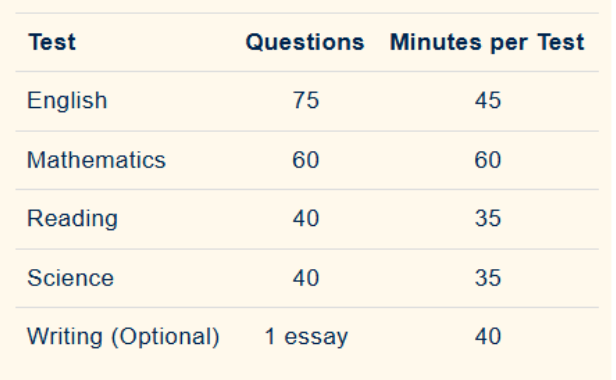
In its current format, the ACT consists of four multiple choice sections: English, Math, Reading, and Science, with an optional writing section. Without the optional writing section, students are given 2 hours and 55 minutes to complete the exam; 3 hours and 35 minutes are allotted to complete the exam with the writing portion.
The table below shows the general breakdown of how each section is organized. Unlike the SAT, the ACT is not adaptive, and students may have the option to take it in either digital or paper format, depending on the testing location and date.
In the English section, students will be asked to answer multiple choice questions based on accompanying passages that evaluate their comprehension and skills in grammar usage, mechanics, and rhetoric. Three main categories of questions are posed: production of writing, knowledge of language, and conventions of standard English.
In the Math section, students will be asked to answer multiple-choice questions of increasing difficulty on topics ranging from algebra to geometry to trigonometry. These questions are intended to test mathematical concepts that students should learn throughout high school. Unlike the SAT, which leans toward algebra-heavy content, the Math section asks more geometry and trigonometry questions. No reference sheet of formulas is provided, although students are allowed to use a permitted calculator throughout the entire Math section.
In the Reading section, students will read various passages and answer questions that measure their comprehension of key ideas and details. Four main reading passages will always be presented in the same order: Prose Fiction/Literary Narrative, Social Science, Humanities, and Natural Science. Students will be asked to evaluate the intended or inferred meanings behind these texts.
The Science section is unique to the ACT and measures the interpretation, analysis, evaluation, reasoning, and problem-solving skills required in the natural sciences. Students will be tested in biology, chemistry, Earth/space sciences, and physics, although only a general knowledge of these concepts is required. They will need to interpret, evaluate, and reason through the provided data to draw conclusions.
Each required section is scored on a scale of 1 to 36, and the average of all four scores is used to calculate an overall composite score. 36 is the highest possible composite score a student can earn. Similar to the SAT, you only earn points for correctly answered questions.
Take the ACT if…
- You want the option of taking a paper exam.
- You do not want to take an adaptive test.
- You want access to a calculator on all math questions.
- You are strong in science.
- You have mastered more advanced math concepts like trigonometry.
- You want or need to take the optional writing section.
Recent ACT Updates (2025–2026)
Beginning in 2025 and continuing into 2026, the ACT has undergone one of its largest transformation in decades. The new updates have reduced the exam length to almost the current length of the SAT. Additionally, the Science section–a longstanding trait of the ACT since its inception–is now be optional. Students can now choose whether or not to take the Science portion. The key subjects–English, Reading, and Math–will continue to be tested. With these recent updates, the ACT attempts to offer students a better testing experience by creating a shorter exam that can be accommodated to suit their academic strengths.
Students should confirm the exact format and section requirements for their specific test date and location, as implementation details may vary.
Plan Ahead
As a college applicant, you can expect to take at least one of these exams as part of your first-year application for admission, as most colleges still require or recommend students to include their test scores for consideration. With the exception of test-blind schools, submitting a strong ACT or SAT score along with your application materials will benefit you in the review process.
Learn about the key differences (and updates) to the SAT and ACT to see which exam may better align with your strengths. Take a diagnostic practice exam for both to see which is a better fit. Earning the score you want on these college entrance examinations will take time and concerted effort. If you have questions about how college entrance examinations are reviewed in your application or which exam to take, contact us! We’re happy to help.

Admissions Evaluator at Vanderbilt Office of Undergraduate Admissions
Associate Director of Admissions and Recruitment at Vanderbilt Law School
4 Years in Vanderbilt Admissions
6,000+ Applications Read and Evaluated
Grace Chee is an Admissions Consultant with Solomon. She holds a Bachelor's Degree from Vanderbilt University in Human and Organizational Development and English, and a Master's in Education in Higher Education Administration from the same institution.